Where Europe Wins in Robotics: Standards
Europe won't out-manufacture China, but it can embrace what mobile robotics is still missing: owning the standards and prototyping layer. this turns a fragmented industry into a real one and creates generational companies along the way.
12/05/2026
Gabriel Méhaignerie
Intro
What could the next trillion dollar European company in robotics look like? We have great research, great talent, and great ecosystems for robotics here. So what does it actually take?
Since the early 2000s, Europe has traded long-term payoffs for short-term wins. Manufacturing went to China first, and design and engineering soon followed. There's a pull to bring some of that back, mostly defence-driven, and that's great. But given how far ahead China is, it's a bit too late on most fronts. To build a generational hardware company in Europe, you have to go beyond the simple discourse of bringing manufacturing back. You build it through a great product that sets a standard in an industry with huge potential. A product that companies in Europe and worldwide actually want to use. That might seem obvious, but it's surprising we don't see more of this, in Europe at least.
Our take: the cost of designing, prototyping, and manufacturing a robotic form factor will go to near zero. Whoever owns the underlying infrastructure that makes that possible becomes indisplaceable, and huge. Concretely, this is standardised components, plus a firmware comms layer, plus a partner-of-production model. Moreover, we think that player will be European.
Why form factor diversity wins. Today, form factor convergence is more forced than chosen. Prototyping a new form factor is so expensive that recently, it seems only humanoids have attracted enough capital to clear the bar. Drop that cost by an order of magnitude and the optimal form factor becomes whatever fits the task. A tunnel inspection robot, a wind turbine maintenance crawler, and a warehouse picker have nothing in common physically. Nothing about humanoid bipedalism is the right answer for any of them. Humanoids will take a meaningful share because the world is built for humans, but they won't take all of it. Specialists become economically viable once prototyping costs collapse, and that creates the layer beneath them.
Obviously, we could be wrong. If general-purpose humanoids end up dominant across most use cases, this thesis ages poorly. We're betting on form factor diversity once the economics allow, and on the infrastructure layer accruing most of the value. Though we have already made an investment in this space that we are very excited about (more info soon). So we have put our money where our mouth is.
1. History: Europe has a good track record for standardisation
The playbook seems to be: be early enough to set some of the rules, own a key piece of systems integration, build a product so good that people adopt it before it's officially "the standard," then open it just enough to let the ecosystem in.
Beckhoff and EtherCAT
Beckhoff is a good example of such a case, and a source of inspiration for hardware founders. they are not a household name, but they are an important company. They are a family-owned, owner-operated business doing roughly €2B in revenue with about 5,300 employees, €80M a year in R&D, and presence in 75+ countries.
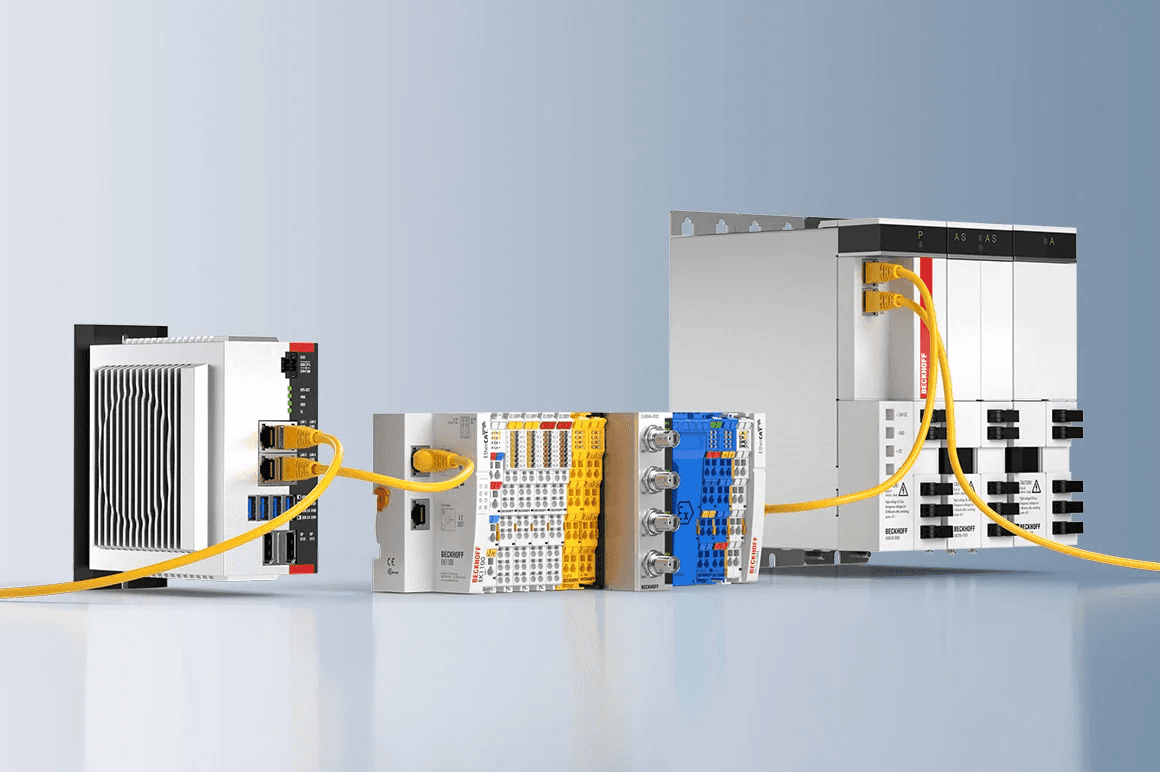
EtherCAT buses and layout - Beckhoff automation
Back in the 90s, it started as a controls cabinet and microprocessor-based electronics business in the garage of the parents' electrical company. As industrial automation grew, they developed into a service-led automation integrator dealing with every industrial protocol on the market. That land grab compounded into the kind of expertise that let them ship a broader, more coherent offering than competitors.
EtherCAT, released in 2003, is now the largest industrial Ethernet standard in the world:
8,650 member companies in 75+ countries (largest fieldbus organisation globally)
105M+ nodes deployed, 16.9M added in 2025 alone
4,000+ unique vendor IDs registered
Standardised internationally for semiconductor manufacturing
Beckhoff is also one of very few European hardware companies actually expanding in China. That says a lot.
What this enabled. Before EtherCAT, industrial automation was a mess of competing fieldbuses (Profibus, Modbus, DeviceNet, CANopen), each siloed by vendor. EtherCAT made deterministic, low-latency communication possible over standard Ethernet, and Beckhoff opened it as a free-to-join standard. Result: an ecosystem of 4,000+ interoperable vendors and a step-change reduction in the cost of building automated systems. Today it's the backbone of semiconductor fabs, packaging lines, machine tools, and increasingly robotic cells. The chips inside the GPUs powering AI are produced on lines running EtherCAT.
More European standards-led winners
ARM (UK, 1990). Designs CPU architectures. 1,000+ licensees, 300B+ ARM-based chips shipped, ~70% of the global population uses an ARM-based device, ~95% gross margins. Now valued near $200B and approaching trillion-dollar territory on the AI tailwind. ARM made the smartphone economy possible: every iPhone, every Android, every set of AirPods runs on ARM. The licensing model meant Apple, Samsung, and Qualcomm could all build their own chips on a shared instruction set, rather than fight over a single proprietary CPU. ARM is the proof that a European standards-led winner can scale into trillion-dollar territory when it rides a generational compute wave. Robotics + AI is plausibly the next one.
Linux (Finland, 1991). Open-source kernel that became the invisible infrastructure of the internet. ~96% of the top million web servers run Linux. AWS, GCP, Azure are all Linux underneath. Android is Linux. Most network gear, embedded systems, and supercomputers run Linux. Without it, the cloud era doesn't happen the way it did. The Linux Foundation and most of its sister organisations are European-led.
The common thread: each one owns a systems integration layer or a component chokepoint, in a market they helped create. Each lowered friction enough that a much larger ecosystem grew on top. Each captured significant value through a sliver of the stack while letting the ecosystem flourish around it. Europe has done this multiple times. Not an accident.
The natural question: which industry is ripe for the same pattern next?
2. Where robotics is today
We think it's mobile robotics. Here's why.
What we mean by mobile robotics. Robots that move through their environment (quadrupeds, humanoids, AMRs in warehouses, inspection crawlers, agricultural platforms, drones in some contexts), as opposed to fixed-position industrial arms. They perceive, plan, and move through space they don't fully control.
That's a fundamentally different problem from industrial robotics, which is mature, runs on EtherCAT and Profinet, and ships at volume in structured environments. Mobile robotics is the wild west: every player builds their own stack from scratch, and bringing a new platform to market is enormously expensive.
A few numbers anchor the contrast:
Industrial (IFR World Robotics 2025): 542,000 robots installed globally in 2024, 4.66M operational stock. Asia 74% / Europe 16% (85,000 units) / Americas 9%.
Mobile robotics: Quadrupeds are further along (Unitree ~23,700 in 2024, ~70% of the global market) but still tiny vs. industrial. Humanoids are sub-5,000 units per platform: Unitree shipped ~5,500 in 2025 (~38% of the ~14,600 humanoids shipped globally). Figure, Apptronik, Agility, Boston Dynamics shipped in the low hundreds.
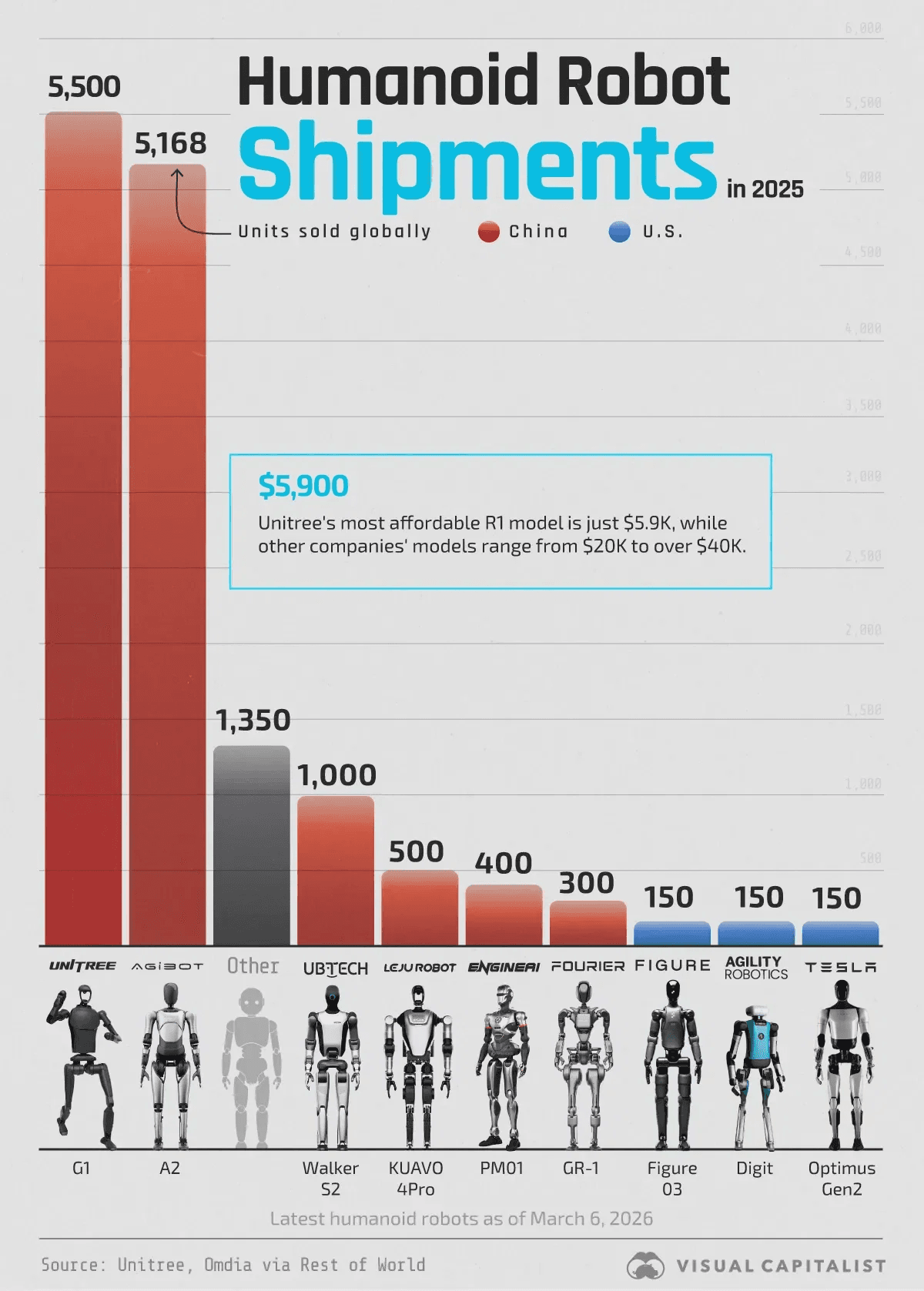
Inside the robot, things are messy. Every component speaks a different protocol. The current approach is to aggregate everything into a black-box AI model that decides what each component does. Inefficient, capability-limited, and it makes form factor changes very expensive.
What's missing is a commonly agreed protocol for mobile robotics, the way EtherCAT exists for industrial automation. Not robot-to-robot networking, but inside the robot: how motor controllers, batteries, sensors, perception modules, and safety buses talk to each other. A uniform framework would also unlock perception/planning, where latency budgets are increasingly the real constraint. No such solution exists today. Which is crazy.
Industrial robotics was here once. Fragmented protocols, no shared stack, every vendor building from scratch. That's where Beckhoff and EtherCAT showed up and locked in 20 years of compounding. The same opening now exists in mobile robotics, and there's no equivalent player yet.
3. Why Europe, not China or the US
The Beckhoff / ARM / Linux pattern is specifically European, and that's not a coincidence. Each one emerged from a specific set of structural conditions that exist here and don't really exist in either China or the US. Those same conditions still apply, and they apply directly to a robotics standards play.
Why those came out of Europe in the first place
Beckhoff: classic Mittelstand. Family ownership, multi-decade horizon, embedded in a regional industrial ecosystem that takes precision engineering seriously. The kind of company that can spend 20 years compounding on a single technology bet because nobody is forcing a 7-year exit.
ARM: emerged from the Cambridge academic computing scene, with patient capital and a deliberate bet on energy efficiency over raw performance. The licensing-not-manufacturing model required a culture that valued IP and ecosystem over vertical control.
Linux: authored in Finland, stewarded through European-led foundations, riding the open-source ethos that came naturally to academic-adjacent culture and survived because no one company could capture it.
The recurring ingredients: patient capital, strong technical universities tied into industry, a cultural disposition toward open governance, and the neutrality that comes from a fragmented market that needs to interoperate. All of these are still here. None are easy to manufacture in either China or the US.
Why not China
Chinese tech tends to optimise for closed, vertically integrated national champions. Unitree, SIASUN, Estun are built to win on cost and volume, not on setting open interoperable standards. Fierce domestic competition might even push toward less interoperability, not more. A Chinese-origin standard also faces structural adoption resistance in the EU, the US, and most of Asia ex-China for trust and data-sovereignty reasons.
China's strengths are real and complementary: Shenzhen iteration speed, production at unbeatable price points (Unitree Go2 from $1,600 vs. Boston Dynamics Spot at $74,500). The right posture is to partner with that, not compete with it.
Why not the US
US standards bodies are fragmented (ANSI, NIST, IEEE, industry consortia all competing), with no single coordinating layer. Big Tech wants proprietary robotics clouds (AWS RoboMaker, Google's Intrinsic), not open standards, and winner-take-all platform reflexes work against shared infrastructure. US-origin standards also face increasing rejection from China and non-aligned markets, which caps the global ceiling.
Why Europe specifically, applied to robotics
None of the following alone is decisive. Together, they describe a structurally favourable position that doesn't really exist anywhere else.
Neutral and interoperable by default. China won't adopt a US-led stack and vice versa; Europe is acceptable to both. Selling into Germany, France, Italy, Switzerland from day one also forces interoperable design as a feature, not an afterthought.
Dense academic pipeline plus a neutral stamp of quality. ETH, EPFL, TUM, Imperial, Delft, IIT Genoa form the densest robotics research cluster outside Boston/Bay Area. Marco Hutter's lab at ETH alone produced ANYbotics, Swiss-Mile, Gravis Robotics, Mimic. "Made in Europe" travels without political baggage.
Certification head start. Mobile robotics in production needs TÜV, IEC 61508, ISO 13849, FSoE, all European. KUKA, ABB, Stäubli, Siemens already do safety cert at scale. Once robotics leaves the lab, certification becomes load-bearing: insurance won't cover uncertified systems, and fleet downtime costs more than the robots themselves.
Open governance is in the cultural DNA. EtherCAT free to join, ARM licenses to anyone, Linux open by design. A robotics components-and-firmware standard fits this natively.
We are not talking about recreating Shenzhen, but rather playing to our constraints. Embracing what China does best, becoming their partner for European customers, but owning the design layer. That is the whole point. Otherwise it's the same trap as 20 years ago.
4. What the next trillion dollar European company looks like
The shape of the winner: a company that accelerates prototyping for mobile robotics by multiple orders of magnitude in both time and cost, and becomes the substrate underneath the entire industry.
What it needs to own and do
Hardware and integrated firmware shipped together. The pair is the product. Sold separately, it defeats the purpose.
Value accrues through services plus the firmware and comms protocol layer. Hardware is the initial selling point. The protocol is what compounds.
Owns the certification process. Functional safety, reliability, uptime guarantees for critical operations.
Acts as a partner of production. Spec sheet to reliable shipped product in a short timeframe, through in-house expertise and strong supply partners (most likely a mix of China and local).
What needs to be true for it to succeed
3-5 lighthouse customers (ideally European) ship at 5,000+ units on the stack. A standard without volume deployment proof is a spec sheet.
A single team wins, with substantial community support behind it. Beckhoff was one company on one bet for 45 years.
Open governance from day one, with regulation staying light. ETG-style free membership and IEC publication. Win on technical merit first, standardise after. Premature EU mandates kill global adoption.
AI and software plug in, not compete. The standard wins if Chinese AI, US foundation models, and European certified middleware all run on it.
If half of those happen, it's a meaningful European company. If all of them happen, the conditions are in place to be the next trillion dollar one.
What this looks like at scale
100+ specialist form factors at ~5,000 units each by 2030: warehouse pickers, agricultural weeders, tunnel inspection crawlers, last-mile delivery wheels, fire response platforms, hospital logistics. Aerones, one of our portfolio companies, is a working example: huge in automated wind turbine maintenance, a market most people haven't heard of but which is genuinely vast. That's roughly 500,000 mobile robots a year on the stack by 2030, every one needing standardised components, firmware, certification, and integration. The trajectory beyond that (millions of units a year, embedded across logistics, infrastructure, agriculture, defence, healthcare) is where the trillion dollar shape actually comes from.
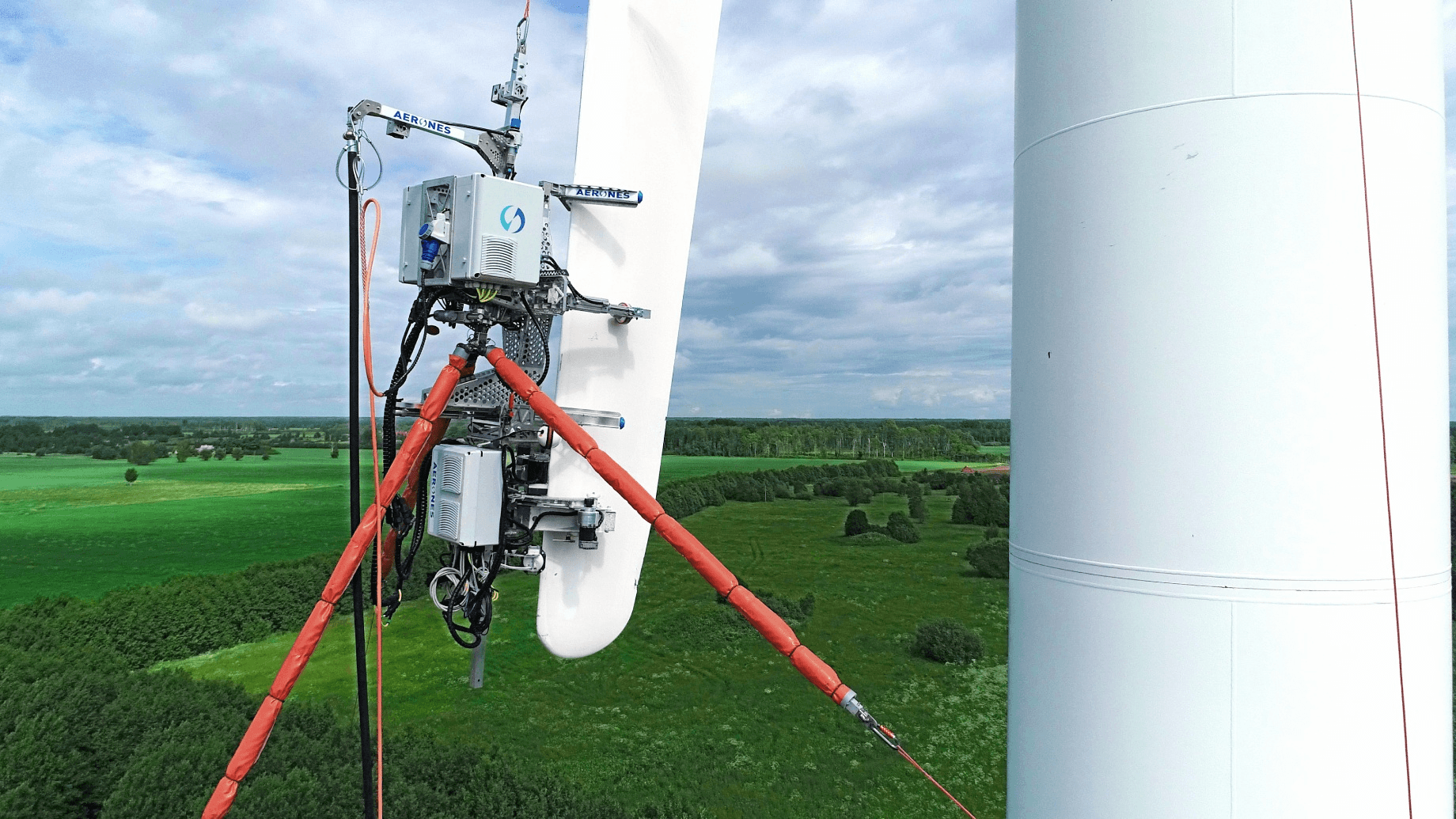
Aerone’s wind turbine inspection and maintenance drone
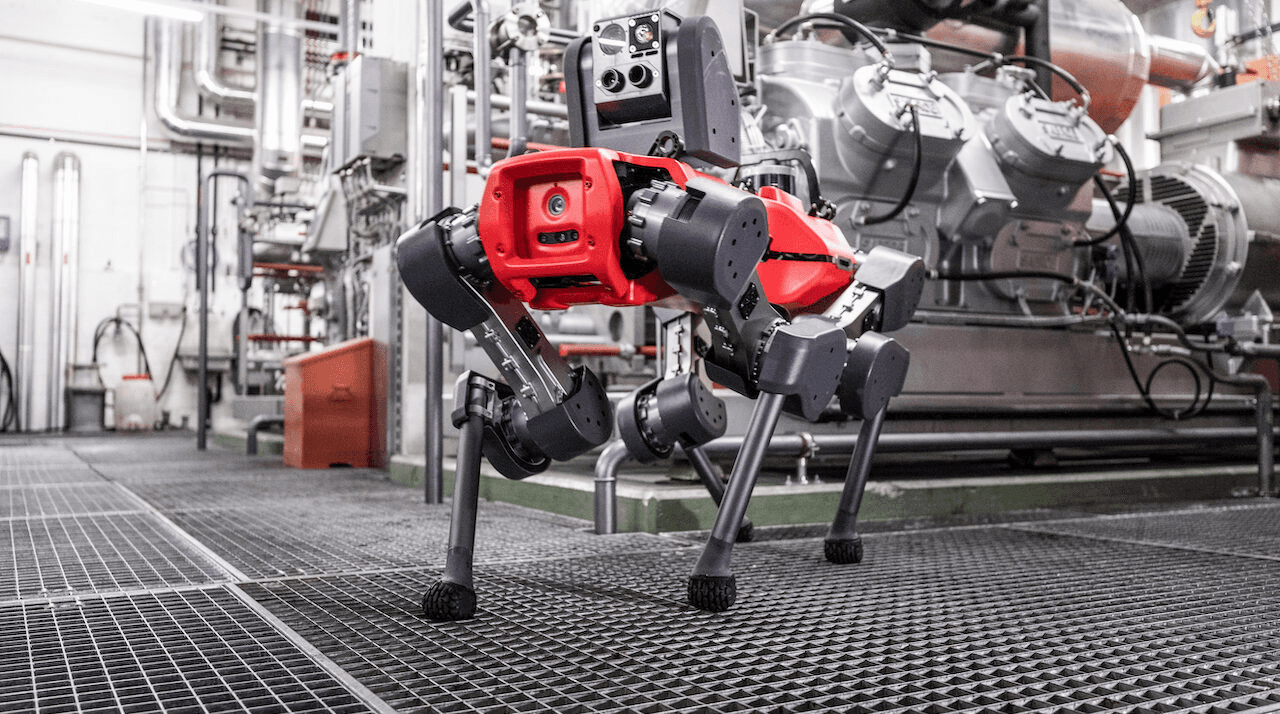
Anybotics’ quadriped
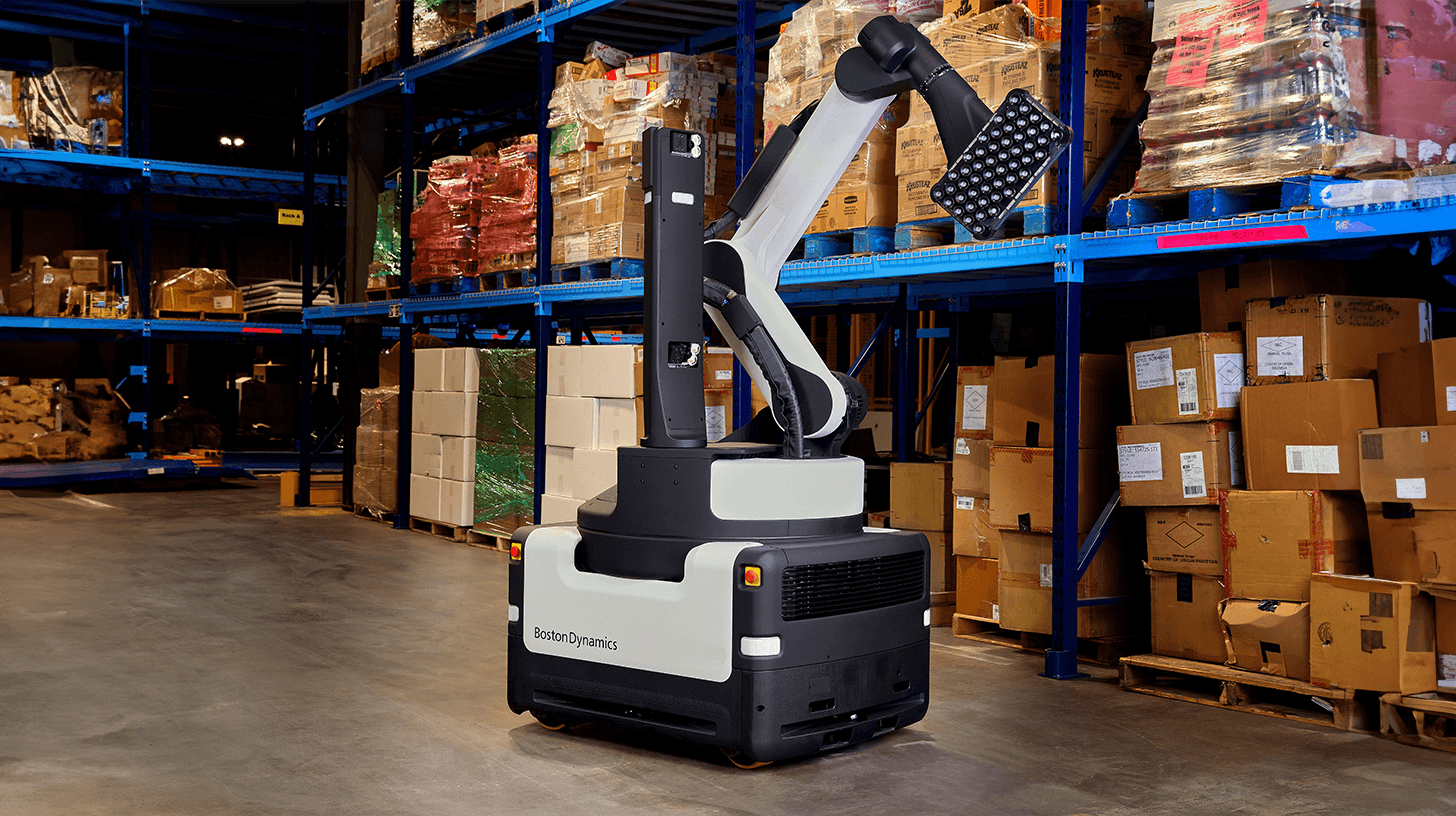
Boston Dynamics’ Stretch
This is the bottleneck for the next wave of robotics, the way ARM sits underneath every smartphone, Linux underneath every cloud, EtherCAT underneath every modern factory. Robotics is the next compute and automation wave.
Conclusion
We started by asking what the next trillion dollar European company in robotics could look like. Our bet, in one line: the company that makes form factor prototyping cheap and owns the standards layer underneath.
This thesis can break in three ways:
Standards emerge, they aren't built. EtherCAT became a standard over 20 years; nobody declared it one in 2003. If volumes materialise faster than the European stack matures, the de facto standard gets set elsewhere first.
AI eats the protocol layer for everything but safety-critical. The "throw a GPU at it, run Python, ROS is dead" trajectory undermines determinism and synchronisation as the main moat. Mobile robotics may bifurcate: ML-everything for research, certified deterministic stack for industrial.
Getting full support from Brussels. If a European standard gets too tied to EU sovereignty mandates or defence procurement, China and the US won't touch it. Lost in EU bureaucracy and irrelevance.
The window is open now. Once a few players ship at scale on whatever stack they happened to use, switching costs lock it in. Whoever moves first and gets it right defines the next 20 years of robotics.
Intro
What could the next trillion dollar European company in robotics look like? We have great research, great talent, and great ecosystems for robotics here. So what does it actually take?
Since the early 2000s, Europe has traded long-term payoffs for short-term wins. Manufacturing went to China first, and design and engineering soon followed. There's a pull to bring some of that back, mostly defence-driven, and that's great. But given how far ahead China is, it's a bit too late on most fronts. To build a generational hardware company in Europe, you have to go beyond the simple discourse of bringing manufacturing back. You build it through a great product that sets a standard in an industry with huge potential. A product that companies in Europe and worldwide actually want to use. That might seem obvious, but it's surprising we don't see more of this, in Europe at least.
Our take: the cost of designing, prototyping, and manufacturing a robotic form factor will go to near zero. Whoever owns the underlying infrastructure that makes that possible becomes indisplaceable, and huge. Concretely, this is standardised components, plus a firmware comms layer, plus a partner-of-production model. Moreover, we think that player will be European.
Why form factor diversity wins. Today, form factor convergence is more forced than chosen. Prototyping a new form factor is so expensive that recently, it seems only humanoids have attracted enough capital to clear the bar. Drop that cost by an order of magnitude and the optimal form factor becomes whatever fits the task. A tunnel inspection robot, a wind turbine maintenance crawler, and a warehouse picker have nothing in common physically. Nothing about humanoid bipedalism is the right answer for any of them. Humanoids will take a meaningful share because the world is built for humans, but they won't take all of it. Specialists become economically viable once prototyping costs collapse, and that creates the layer beneath them.
Obviously, we could be wrong. If general-purpose humanoids end up dominant across most use cases, this thesis ages poorly. We're betting on form factor diversity once the economics allow, and on the infrastructure layer accruing most of the value. Though we have already made an investment in this space that we are very excited about (more info soon). So we have put our money where our mouth is.
1. History: Europe has a good track record for standardisation
The playbook seems to be: be early enough to set some of the rules, own a key piece of systems integration, build a product so good that people adopt it before it's officially "the standard," then open it just enough to let the ecosystem in.
Beckhoff and EtherCAT
Beckhoff is a good example of such a case, and a source of inspiration for hardware founders. they are not a household name, but they are an important company. They are a family-owned, owner-operated business doing roughly €2B in revenue with about 5,300 employees, €80M a year in R&D, and presence in 75+ countries.
EtherCAT buses and layout - Beckhoff automation
Back in the 90s, it started as a controls cabinet and microprocessor-based electronics business in the garage of the parents' electrical company. As industrial automation grew, they developed into a service-led automation integrator dealing with every industrial protocol on the market. That land grab compounded into the kind of expertise that let them ship a broader, more coherent offering than competitors.
EtherCAT, released in 2003, is now the largest industrial Ethernet standard in the world:
8,650 member companies in 75+ countries (largest fieldbus organisation globally)
105M+ nodes deployed, 16.9M added in 2025 alone
4,000+ unique vendor IDs registered
Standardised internationally for semiconductor manufacturing
Beckhoff is also one of very few European hardware companies actually expanding in China. That says a lot.
What this enabled. Before EtherCAT, industrial automation was a mess of competing fieldbuses (Profibus, Modbus, DeviceNet, CANopen), each siloed by vendor. EtherCAT made deterministic, low-latency communication possible over standard Ethernet, and Beckhoff opened it as a free-to-join standard. Result: an ecosystem of 4,000+ interoperable vendors and a step-change reduction in the cost of building automated systems. Today it's the backbone of semiconductor fabs, packaging lines, machine tools, and increasingly robotic cells. The chips inside the GPUs powering AI are produced on lines running EtherCAT.
More European standards-led winners
ARM (UK, 1990). Designs CPU architectures. 1,000+ licensees, 300B+ ARM-based chips shipped, ~70% of the global population uses an ARM-based device, ~95% gross margins. Now valued near $200B and approaching trillion-dollar territory on the AI tailwind. ARM made the smartphone economy possible: every iPhone, every Android, every set of AirPods runs on ARM. The licensing model meant Apple, Samsung, and Qualcomm could all build their own chips on a shared instruction set, rather than fight over a single proprietary CPU. ARM is the proof that a European standards-led winner can scale into trillion-dollar territory when it rides a generational compute wave. Robotics + AI is plausibly the next one.
Linux (Finland, 1991). Open-source kernel that became the invisible infrastructure of the internet. ~96% of the top million web servers run Linux. AWS, GCP, Azure are all Linux underneath. Android is Linux. Most network gear, embedded systems, and supercomputers run Linux. Without it, the cloud era doesn't happen the way it did. The Linux Foundation and most of its sister organisations are European-led.
The common thread: each one owns a systems integration layer or a component chokepoint, in a market they helped create. Each lowered friction enough that a much larger ecosystem grew on top. Each captured significant value through a sliver of the stack while letting the ecosystem flourish around it. Europe has done this multiple times. Not an accident.
The natural question: which industry is ripe for the same pattern next?
2. Where robotics is today
We think it's mobile robotics. Here's why.
What we mean by mobile robotics. Robots that move through their environment (quadrupeds, humanoids, AMRs in warehouses, inspection crawlers, agricultural platforms, drones in some contexts), as opposed to fixed-position industrial arms. They perceive, plan, and move through space they don't fully control.
That's a fundamentally different problem from industrial robotics, which is mature, runs on EtherCAT and Profinet, and ships at volume in structured environments. Mobile robotics is the wild west: every player builds their own stack from scratch, and bringing a new platform to market is enormously expensive.
A few numbers anchor the contrast:
Industrial (IFR World Robotics 2025): 542,000 robots installed globally in 2024, 4.66M operational stock. Asia 74% / Europe 16% (85,000 units) / Americas 9%.
Mobile robotics: Quadrupeds are further along (Unitree ~23,700 in 2024, ~70% of the global market) but still tiny vs. industrial. Humanoids are sub-5,000 units per platform: Unitree shipped ~5,500 in 2025 (~38% of the ~14,600 humanoids shipped globally). Figure, Apptronik, Agility, Boston Dynamics shipped in the low hundreds.
Inside the robot, things are messy. Every component speaks a different protocol. The current approach is to aggregate everything into a black-box AI model that decides what each component does. Inefficient, capability-limited, and it makes form factor changes very expensive.
What's missing is a commonly agreed protocol for mobile robotics, the way EtherCAT exists for industrial automation. Not robot-to-robot networking, but inside the robot: how motor controllers, batteries, sensors, perception modules, and safety buses talk to each other. A uniform framework would also unlock perception/planning, where latency budgets are increasingly the real constraint. No such solution exists today. Which is crazy.
Industrial robotics was here once. Fragmented protocols, no shared stack, every vendor building from scratch. That's where Beckhoff and EtherCAT showed up and locked in 20 years of compounding. The same opening now exists in mobile robotics, and there's no equivalent player yet.
3. Why Europe, not China or the US
The Beckhoff / ARM / Linux pattern is specifically European, and that's not a coincidence. Each one emerged from a specific set of structural conditions that exist here and don't really exist in either China or the US. Those same conditions still apply, and they apply directly to a robotics standards play.
Why those came out of Europe in the first place
Beckhoff: classic Mittelstand. Family ownership, multi-decade horizon, embedded in a regional industrial ecosystem that takes precision engineering seriously. The kind of company that can spend 20 years compounding on a single technology bet because nobody is forcing a 7-year exit.
ARM: emerged from the Cambridge academic computing scene, with patient capital and a deliberate bet on energy efficiency over raw performance. The licensing-not-manufacturing model required a culture that valued IP and ecosystem over vertical control.
Linux: authored in Finland, stewarded through European-led foundations, riding the open-source ethos that came naturally to academic-adjacent culture and survived because no one company could capture it.
The recurring ingredients: patient capital, strong technical universities tied into industry, a cultural disposition toward open governance, and the neutrality that comes from a fragmented market that needs to interoperate. All of these are still here. None are easy to manufacture in either China or the US.
Why not China
Chinese tech tends to optimise for closed, vertically integrated national champions. Unitree, SIASUN, Estun are built to win on cost and volume, not on setting open interoperable standards. Fierce domestic competition might even push toward less interoperability, not more. A Chinese-origin standard also faces structural adoption resistance in the EU, the US, and most of Asia ex-China for trust and data-sovereignty reasons.
China's strengths are real and complementary: Shenzhen iteration speed, production at unbeatable price points (Unitree Go2 from $1,600 vs. Boston Dynamics Spot at $74,500). The right posture is to partner with that, not compete with it.
Why not the US
US standards bodies are fragmented (ANSI, NIST, IEEE, industry consortia all competing), with no single coordinating layer. Big Tech wants proprietary robotics clouds (AWS RoboMaker, Google's Intrinsic), not open standards, and winner-take-all platform reflexes work against shared infrastructure. US-origin standards also face increasing rejection from China and non-aligned markets, which caps the global ceiling.
Why Europe specifically, applied to robotics
None of the following alone is decisive. Together, they describe a structurally favourable position that doesn't really exist anywhere else.
Neutral and interoperable by default. China won't adopt a US-led stack and vice versa; Europe is acceptable to both. Selling into Germany, France, Italy, Switzerland from day one also forces interoperable design as a feature, not an afterthought.
Dense academic pipeline plus a neutral stamp of quality. ETH, EPFL, TUM, Imperial, Delft, IIT Genoa form the densest robotics research cluster outside Boston/Bay Area. Marco Hutter's lab at ETH alone produced ANYbotics, Swiss-Mile, Gravis Robotics, Mimic. "Made in Europe" travels without political baggage.
Certification head start. Mobile robotics in production needs TÜV, IEC 61508, ISO 13849, FSoE, all European. KUKA, ABB, Stäubli, Siemens already do safety cert at scale. Once robotics leaves the lab, certification becomes load-bearing: insurance won't cover uncertified systems, and fleet downtime costs more than the robots themselves.
Open governance is in the cultural DNA. EtherCAT free to join, ARM licenses to anyone, Linux open by design. A robotics components-and-firmware standard fits this natively.
We are not talking about recreating Shenzhen, but rather playing to our constraints. Embracing what China does best, becoming their partner for European customers, but owning the design layer. That is the whole point. Otherwise it's the same trap as 20 years ago.
4. What the next trillion dollar European company looks like
The shape of the winner: a company that accelerates prototyping for mobile robotics by multiple orders of magnitude in both time and cost, and becomes the substrate underneath the entire industry.
What it needs to own and do
Hardware and integrated firmware shipped together. The pair is the product. Sold separately, it defeats the purpose.
Value accrues through services plus the firmware and comms protocol layer. Hardware is the initial selling point. The protocol is what compounds.
Owns the certification process. Functional safety, reliability, uptime guarantees for critical operations.
Acts as a partner of production. Spec sheet to reliable shipped product in a short timeframe, through in-house expertise and strong supply partners (most likely a mix of China and local).
What needs to be true for it to succeed
3-5 lighthouse customers (ideally European) ship at 5,000+ units on the stack. A standard without volume deployment proof is a spec sheet.
A single team wins, with substantial community support behind it. Beckhoff was one company on one bet for 45 years.
Open governance from day one, with regulation staying light. ETG-style free membership and IEC publication. Win on technical merit first, standardise after. Premature EU mandates kill global adoption.
AI and software plug in, not compete. The standard wins if Chinese AI, US foundation models, and European certified middleware all run on it.
If half of those happen, it's a meaningful European company. If all of them happen, the conditions are in place to be the next trillion dollar one.
What this looks like at scale
100+ specialist form factors at ~5,000 units each by 2030: warehouse pickers, agricultural weeders, tunnel inspection crawlers, last-mile delivery wheels, fire response platforms, hospital logistics. Aerones, one of our portfolio companies, is a working example: huge in automated wind turbine maintenance, a market most people haven't heard of but which is genuinely vast. That's roughly 500,000 mobile robots a year on the stack by 2030, every one needing standardised components, firmware, certification, and integration. The trajectory beyond that (millions of units a year, embedded across logistics, infrastructure, agriculture, defence, healthcare) is where the trillion dollar shape actually comes from.
Aerone’s wind turbine inspection and maintenance drone
Anybotics’ quadriped
Boston Dynamics’ Stretch
This is the bottleneck for the next wave of robotics, the way ARM sits underneath every smartphone, Linux underneath every cloud, EtherCAT underneath every modern factory. Robotics is the next compute and automation wave.
Conclusion
We started by asking what the next trillion dollar European company in robotics could look like. Our bet, in one line: the company that makes form factor prototyping cheap and owns the standards layer underneath.
This thesis can break in three ways:
Standards emerge, they aren't built. EtherCAT became a standard over 20 years; nobody declared it one in 2003. If volumes materialise faster than the European stack matures, the de facto standard gets set elsewhere first.
AI eats the protocol layer for everything but safety-critical. The "throw a GPU at it, run Python, ROS is dead" trajectory undermines determinism and synchronisation as the main moat. Mobile robotics may bifurcate: ML-everything for research, certified deterministic stack for industrial.
Getting full support from Brussels. If a European standard gets too tied to EU sovereignty mandates or defence procurement, China and the US won't touch it. Lost in EU bureaucracy and irrelevance.
The window is open now. Once a few players ship at scale on whatever stack they happened to use, switching costs lock it in. Whoever moves first and gets it right defines the next 20 years of robotics.
Intro
What could the next trillion dollar European company in robotics look like? We have great research, great talent, and great ecosystems for robotics here. So what does it actually take?
Since the early 2000s, Europe has traded long-term payoffs for short-term wins. Manufacturing went to China first, and design and engineering soon followed. There's a pull to bring some of that back, mostly defence-driven, and that's great. But given how far ahead China is, it's a bit too late on most fronts. To build a generational hardware company in Europe, you have to go beyond the simple discourse of bringing manufacturing back. You build it through a great product that sets a standard in an industry with huge potential. A product that companies in Europe and worldwide actually want to use. That might seem obvious, but it's surprising we don't see more of this, in Europe at least.
Our take: the cost of designing, prototyping, and manufacturing a robotic form factor will go to near zero. Whoever owns the underlying infrastructure that makes that possible becomes indisplaceable, and huge. Concretely, this is standardised components, plus a firmware comms layer, plus a partner-of-production model. Moreover, we think that player will be European.
Why form factor diversity wins. Today, form factor convergence is more forced than chosen. Prototyping a new form factor is so expensive that recently, it seems only humanoids have attracted enough capital to clear the bar. Drop that cost by an order of magnitude and the optimal form factor becomes whatever fits the task. A tunnel inspection robot, a wind turbine maintenance crawler, and a warehouse picker have nothing in common physically. Nothing about humanoid bipedalism is the right answer for any of them. Humanoids will take a meaningful share because the world is built for humans, but they won't take all of it. Specialists become economically viable once prototyping costs collapse, and that creates the layer beneath them.
Obviously, we could be wrong. If general-purpose humanoids end up dominant across most use cases, this thesis ages poorly. We're betting on form factor diversity once the economics allow, and on the infrastructure layer accruing most of the value. Though we have already made an investment in this space that we are very excited about (more info soon). So we have put our money where our mouth is.
1. History: Europe has a good track record for standardisation
The playbook seems to be: be early enough to set some of the rules, own a key piece of systems integration, build a product so good that people adopt it before it's officially "the standard," then open it just enough to let the ecosystem in.
Beckhoff and EtherCAT
Beckhoff is a good example of such a case, and a source of inspiration for hardware founders. they are not a household name, but they are an important company. They are a family-owned, owner-operated business doing roughly €2B in revenue with about 5,300 employees, €80M a year in R&D, and presence in 75+ countries.
EtherCAT buses and layout - Beckhoff automation
Back in the 90s, it started as a controls cabinet and microprocessor-based electronics business in the garage of the parents' electrical company. As industrial automation grew, they developed into a service-led automation integrator dealing with every industrial protocol on the market. That land grab compounded into the kind of expertise that let them ship a broader, more coherent offering than competitors.
EtherCAT, released in 2003, is now the largest industrial Ethernet standard in the world:
8,650 member companies in 75+ countries (largest fieldbus organisation globally)
105M+ nodes deployed, 16.9M added in 2025 alone
4,000+ unique vendor IDs registered
Standardised internationally for semiconductor manufacturing
Beckhoff is also one of very few European hardware companies actually expanding in China. That says a lot.
What this enabled. Before EtherCAT, industrial automation was a mess of competing fieldbuses (Profibus, Modbus, DeviceNet, CANopen), each siloed by vendor. EtherCAT made deterministic, low-latency communication possible over standard Ethernet, and Beckhoff opened it as a free-to-join standard. Result: an ecosystem of 4,000+ interoperable vendors and a step-change reduction in the cost of building automated systems. Today it's the backbone of semiconductor fabs, packaging lines, machine tools, and increasingly robotic cells. The chips inside the GPUs powering AI are produced on lines running EtherCAT.
More European standards-led winners
ARM (UK, 1990). Designs CPU architectures. 1,000+ licensees, 300B+ ARM-based chips shipped, ~70% of the global population uses an ARM-based device, ~95% gross margins. Now valued near $200B and approaching trillion-dollar territory on the AI tailwind. ARM made the smartphone economy possible: every iPhone, every Android, every set of AirPods runs on ARM. The licensing model meant Apple, Samsung, and Qualcomm could all build their own chips on a shared instruction set, rather than fight over a single proprietary CPU. ARM is the proof that a European standards-led winner can scale into trillion-dollar territory when it rides a generational compute wave. Robotics + AI is plausibly the next one.
Linux (Finland, 1991). Open-source kernel that became the invisible infrastructure of the internet. ~96% of the top million web servers run Linux. AWS, GCP, Azure are all Linux underneath. Android is Linux. Most network gear, embedded systems, and supercomputers run Linux. Without it, the cloud era doesn't happen the way it did. The Linux Foundation and most of its sister organisations are European-led.
The common thread: each one owns a systems integration layer or a component chokepoint, in a market they helped create. Each lowered friction enough that a much larger ecosystem grew on top. Each captured significant value through a sliver of the stack while letting the ecosystem flourish around it. Europe has done this multiple times. Not an accident.
The natural question: which industry is ripe for the same pattern next?
2. Where robotics is today
We think it's mobile robotics. Here's why.
What we mean by mobile robotics. Robots that move through their environment (quadrupeds, humanoids, AMRs in warehouses, inspection crawlers, agricultural platforms, drones in some contexts), as opposed to fixed-position industrial arms. They perceive, plan, and move through space they don't fully control.
That's a fundamentally different problem from industrial robotics, which is mature, runs on EtherCAT and Profinet, and ships at volume in structured environments. Mobile robotics is the wild west: every player builds their own stack from scratch, and bringing a new platform to market is enormously expensive.
A few numbers anchor the contrast:
Industrial (IFR World Robotics 2025): 542,000 robots installed globally in 2024, 4.66M operational stock. Asia 74% / Europe 16% (85,000 units) / Americas 9%.
Mobile robotics: Quadrupeds are further along (Unitree ~23,700 in 2024, ~70% of the global market) but still tiny vs. industrial. Humanoids are sub-5,000 units per platform: Unitree shipped ~5,500 in 2025 (~38% of the ~14,600 humanoids shipped globally). Figure, Apptronik, Agility, Boston Dynamics shipped in the low hundreds.
Inside the robot, things are messy. Every component speaks a different protocol. The current approach is to aggregate everything into a black-box AI model that decides what each component does. Inefficient, capability-limited, and it makes form factor changes very expensive.
What's missing is a commonly agreed protocol for mobile robotics, the way EtherCAT exists for industrial automation. Not robot-to-robot networking, but inside the robot: how motor controllers, batteries, sensors, perception modules, and safety buses talk to each other. A uniform framework would also unlock perception/planning, where latency budgets are increasingly the real constraint. No such solution exists today. Which is crazy.
Industrial robotics was here once. Fragmented protocols, no shared stack, every vendor building from scratch. That's where Beckhoff and EtherCAT showed up and locked in 20 years of compounding. The same opening now exists in mobile robotics, and there's no equivalent player yet.
3. Why Europe, not China or the US
The Beckhoff / ARM / Linux pattern is specifically European, and that's not a coincidence. Each one emerged from a specific set of structural conditions that exist here and don't really exist in either China or the US. Those same conditions still apply, and they apply directly to a robotics standards play.
Why those came out of Europe in the first place
Beckhoff: classic Mittelstand. Family ownership, multi-decade horizon, embedded in a regional industrial ecosystem that takes precision engineering seriously. The kind of company that can spend 20 years compounding on a single technology bet because nobody is forcing a 7-year exit.
ARM: emerged from the Cambridge academic computing scene, with patient capital and a deliberate bet on energy efficiency over raw performance. The licensing-not-manufacturing model required a culture that valued IP and ecosystem over vertical control.
Linux: authored in Finland, stewarded through European-led foundations, riding the open-source ethos that came naturally to academic-adjacent culture and survived because no one company could capture it.
The recurring ingredients: patient capital, strong technical universities tied into industry, a cultural disposition toward open governance, and the neutrality that comes from a fragmented market that needs to interoperate. All of these are still here. None are easy to manufacture in either China or the US.
Why not China
Chinese tech tends to optimise for closed, vertically integrated national champions. Unitree, SIASUN, Estun are built to win on cost and volume, not on setting open interoperable standards. Fierce domestic competition might even push toward less interoperability, not more. A Chinese-origin standard also faces structural adoption resistance in the EU, the US, and most of Asia ex-China for trust and data-sovereignty reasons.
China's strengths are real and complementary: Shenzhen iteration speed, production at unbeatable price points (Unitree Go2 from $1,600 vs. Boston Dynamics Spot at $74,500). The right posture is to partner with that, not compete with it.
Why not the US
US standards bodies are fragmented (ANSI, NIST, IEEE, industry consortia all competing), with no single coordinating layer. Big Tech wants proprietary robotics clouds (AWS RoboMaker, Google's Intrinsic), not open standards, and winner-take-all platform reflexes work against shared infrastructure. US-origin standards also face increasing rejection from China and non-aligned markets, which caps the global ceiling.
Why Europe specifically, applied to robotics
None of the following alone is decisive. Together, they describe a structurally favourable position that doesn't really exist anywhere else.
Neutral and interoperable by default. China won't adopt a US-led stack and vice versa; Europe is acceptable to both. Selling into Germany, France, Italy, Switzerland from day one also forces interoperable design as a feature, not an afterthought.
Dense academic pipeline plus a neutral stamp of quality. ETH, EPFL, TUM, Imperial, Delft, IIT Genoa form the densest robotics research cluster outside Boston/Bay Area. Marco Hutter's lab at ETH alone produced ANYbotics, Swiss-Mile, Gravis Robotics, Mimic. "Made in Europe" travels without political baggage.
Certification head start. Mobile robotics in production needs TÜV, IEC 61508, ISO 13849, FSoE, all European. KUKA, ABB, Stäubli, Siemens already do safety cert at scale. Once robotics leaves the lab, certification becomes load-bearing: insurance won't cover uncertified systems, and fleet downtime costs more than the robots themselves.
Open governance is in the cultural DNA. EtherCAT free to join, ARM licenses to anyone, Linux open by design. A robotics components-and-firmware standard fits this natively.
We are not talking about recreating Shenzhen, but rather playing to our constraints. Embracing what China does best, becoming their partner for European customers, but owning the design layer. That is the whole point. Otherwise it's the same trap as 20 years ago.
4. What the next trillion dollar European company looks like
The shape of the winner: a company that accelerates prototyping for mobile robotics by multiple orders of magnitude in both time and cost, and becomes the substrate underneath the entire industry.
What it needs to own and do
Hardware and integrated firmware shipped together. The pair is the product. Sold separately, it defeats the purpose.
Value accrues through services plus the firmware and comms protocol layer. Hardware is the initial selling point. The protocol is what compounds.
Owns the certification process. Functional safety, reliability, uptime guarantees for critical operations.
Acts as a partner of production. Spec sheet to reliable shipped product in a short timeframe, through in-house expertise and strong supply partners (most likely a mix of China and local).
What needs to be true for it to succeed
3-5 lighthouse customers (ideally European) ship at 5,000+ units on the stack. A standard without volume deployment proof is a spec sheet.
A single team wins, with substantial community support behind it. Beckhoff was one company on one bet for 45 years.
Open governance from day one, with regulation staying light. ETG-style free membership and IEC publication. Win on technical merit first, standardise after. Premature EU mandates kill global adoption.
AI and software plug in, not compete. The standard wins if Chinese AI, US foundation models, and European certified middleware all run on it.
If half of those happen, it's a meaningful European company. If all of them happen, the conditions are in place to be the next trillion dollar one.
What this looks like at scale
100+ specialist form factors at ~5,000 units each by 2030: warehouse pickers, agricultural weeders, tunnel inspection crawlers, last-mile delivery wheels, fire response platforms, hospital logistics. Aerones, one of our portfolio companies, is a working example: huge in automated wind turbine maintenance, a market most people haven't heard of but which is genuinely vast. That's roughly 500,000 mobile robots a year on the stack by 2030, every one needing standardised components, firmware, certification, and integration. The trajectory beyond that (millions of units a year, embedded across logistics, infrastructure, agriculture, defence, healthcare) is where the trillion dollar shape actually comes from.
Aerone’s wind turbine inspection and maintenance drone
Anybotics’ quadriped
Boston Dynamics’ Stretch
This is the bottleneck for the next wave of robotics, the way ARM sits underneath every smartphone, Linux underneath every cloud, EtherCAT underneath every modern factory. Robotics is the next compute and automation wave.
Conclusion
We started by asking what the next trillion dollar European company in robotics could look like. Our bet, in one line: the company that makes form factor prototyping cheap and owns the standards layer underneath.
This thesis can break in three ways:
Standards emerge, they aren't built. EtherCAT became a standard over 20 years; nobody declared it one in 2003. If volumes materialise faster than the European stack matures, the de facto standard gets set elsewhere first.
AI eats the protocol layer for everything but safety-critical. The "throw a GPU at it, run Python, ROS is dead" trajectory undermines determinism and synchronisation as the main moat. Mobile robotics may bifurcate: ML-everything for research, certified deterministic stack for industrial.
Getting full support from Brussels. If a European standard gets too tied to EU sovereignty mandates or defence procurement, China and the US won't touch it. Lost in EU bureaucracy and irrelevance.
The window is open now. Once a few players ship at scale on whatever stack they happened to use, switching costs lock it in. Whoever moves first and gets it right defines the next 20 years of robotics.